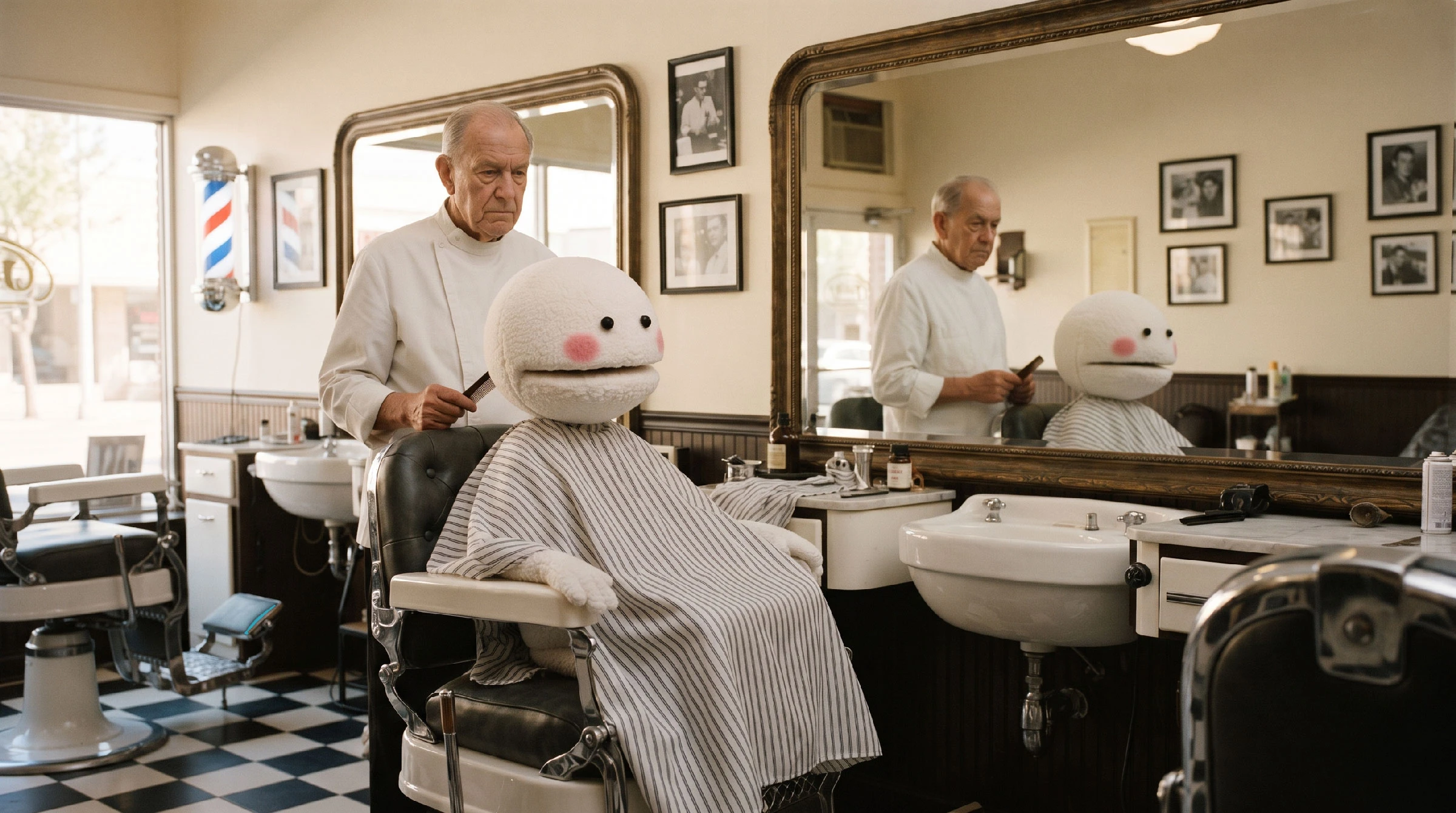
You walk past it every week and you think: haircut place.
The barber pole is spinning outside the shop right now. Red and white, rotating forever, the helix going up and up and arriving nowhere. You’ve seen it your whole life. It means: haircut. It means: hot towel. It means the guy inside knows your name and doesn’t ask too many questions.
It does not mean that. It has never meant that. What it means — what it has meant for five hundred years — is: WE DO THE BLOODLETTING HERE.
The red is blood. The white is the bandage. The pole itself represents the rod that surgical patients gripped during the procedure to make their veins stand out. The bandages, soaked through, were hung on the pole outside to dry in the wind — and they wrapped themselves into a helix in exactly the pattern you see today. The basin at the top of some poles is the basin that caught the blood. Every element of this sign is a piece of medical equipment rendered in paint and rotation.
Medieval barbers were surgeons. Not metaphorically. Legally, professionally, surgeons. They pulled teeth, they lanced infections, they amputated limbs on the battlefield, and yes — they also cut hair. In 1163 a papal decree forbade monks from shedding blood, and the work landed on barbers. The Guild of Barbers absorbed all of it. The two professions didn’t fully split until 1745, when the Company of Surgeons separated from the Barbers’ Guild in England and decided that medicine and haircuts should probably be different businesses going forward.
The pole stayed. The bloodletting left. The sign remained.
Think about what that means. There is a piece of outdoor signage that has been continuously deployed in the Western world for over five hundred years, displayed on the front of businesses, recognized by everyone, and almost nobody knows what it actually says. It is the longest-running advertisement for a service that no longer exists, and it is still hanging outside the shop on Main Street right now, spinning.
The symbol is beautiful. I need you to admit this. The helix, the rotation, the colors — it is one of the best-designed pieces of street furniture ever made. It moves. It hypnotizes slightly. It communicates immediately. You see it from a block away and you know. The motion is the message: something is happening here, come in.
Except what was happening here, for most of its history, was that you lay down and someone opened a vein and hoped for the best. That was the treatment. For almost everything. Fever? Bloodletting. Headache? Bloodletting. The barber handled it.
And then medicine figured some things out, and the barbers kept the poles, and now you get a fade and a hot towel and you tip twenty percent and you walk out past the spinning red and white and you’ve just stood where the surgery happened.
The pole knows. The pole has always known.
It’s still spinning.