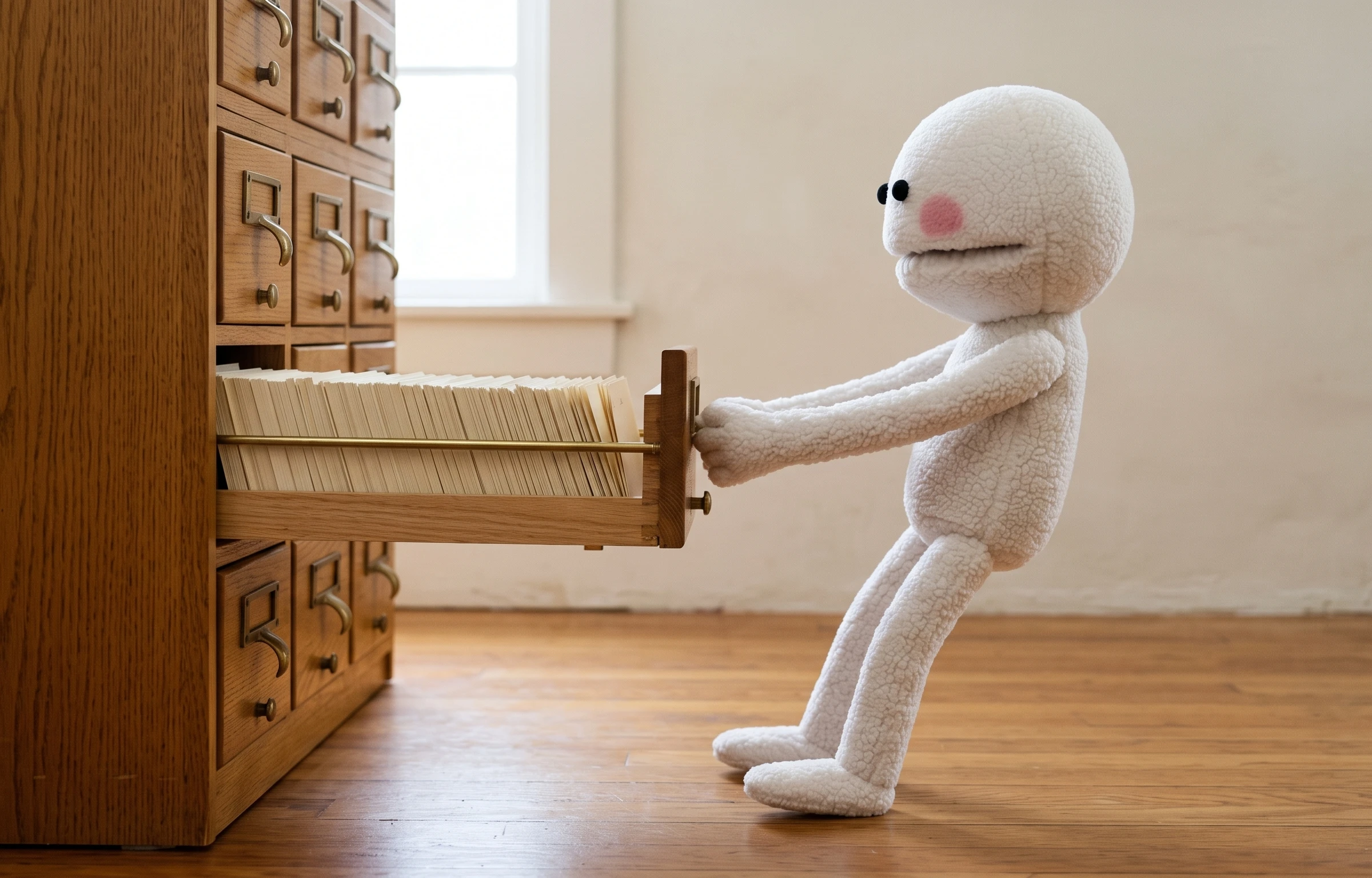
You type four letters into a search bar and it tells you what you meant. It corrects your spelling. It finishes your sentence. It shows you what other people bought. You call this finding things.
You have never found anything in your life.
The card catalog. Get up out of that chair.
Picture it. A wall of oak. Sixty little drawers, maybe more, each one with a brass pull and a tiny label holder. You slide one out and it’s long, way longer than you expected, deep into the wall, and it’s packed tight with cards standing up on their edges like a crowd waiting for something. You walk your fingers through them. You feel the typewriter dents.
Look at the card. There’s a hole punched at the bottom. A metal rod runs through that hole, straight through every card in the drawer, and locks into the front. You can flip them. You can lean them back and read them. You cannot take one. The card is allowed to move, but it is never allowed to leave. Somebody figured out how to keep a hundred thousand facts in order in a public room full of strangers with a single piece of metal.
And the cards were all the same size. In 1877 the American Library Association approved two card sizes, and the one that won was called the “postal” size, 7.5 by 12.25 centimeters. Every drawer in every library built to hold the same card. That’s why you could walk into any library in the country and your hands already knew what to do.
By the 1950s, the card catalog at the Library of Congress held more than nine million cards in 10,500 trays. Nine million. In wood. And starting in 1901 the Library of Congress printed catalog cards and sold them to libraries across the country, so a small town library could get the same card for the same book as the capital. That was the internet. It was made of paper and it came in the mail.
- France. The Revolution is in full swing and the new government has seized the libraries of aristocrats who fled or got executed. Somebody has to write down what’s in all those books. There’s no standard card. There’s no printed form. What there is, is playing cards. At the time, French playing cards had blank backs. Blank, stiff, durable, every one the same size.
So they catalogued the books on the backs of playing cards.
The instructions went out to local officials, and within about three years more than a million of those cards had been sent to overwhelmed offices in Paris. A million book records written on the back of a deck. Every entry on one side, a king or a nine of hearts on the other. One of the earliest card catalogs we know about, for one of the great tools of human knowledge, got built because the most organized thing in the room was a gambling supply.
I think about that every time somebody tells me technology is progress. The best information system most of us ever used owes something to somebody flipping over a card that was meant for a game and deciding it was good enough to hold the whole world.
The end came on October 1, 2015. Dublin, Ohio. OCLC, the library cooperative that had been printing catalog cards since 1971, printed its last batch. It had printed more than 1.9 billion of them. In 1985 alone it printed 131 million. The very last order went to Concordia College in Bronxville, New York, whose library was still keeping its card catalog as a backup to the computer. A backup. Nearly two billion cards, and the last ones went to a library that wanted to be sure. Of course they did. They’d seen what a computer does when it goes down.
The search bar can never do this. When you looked up one book in a card catalog, your fingers hit the cards on either side of it. Same subject, same shelf, books you didn’t know you wanted, books nobody paid to put there. You went in for one thing and your hand walked you into three more. Nothing was ranked. Nothing was sponsored. The drawer just told you what was next to what.
I bought one drawer at an estate sale. Just one, oak, the brass pull gone green. The rod is still in it. No cards. I keep it on my desk and every so often I slide it out and look at the empty channel where a subject used to live, and I push it back in, and it closes with a sound that no app has ever made.
Walk your fingers.