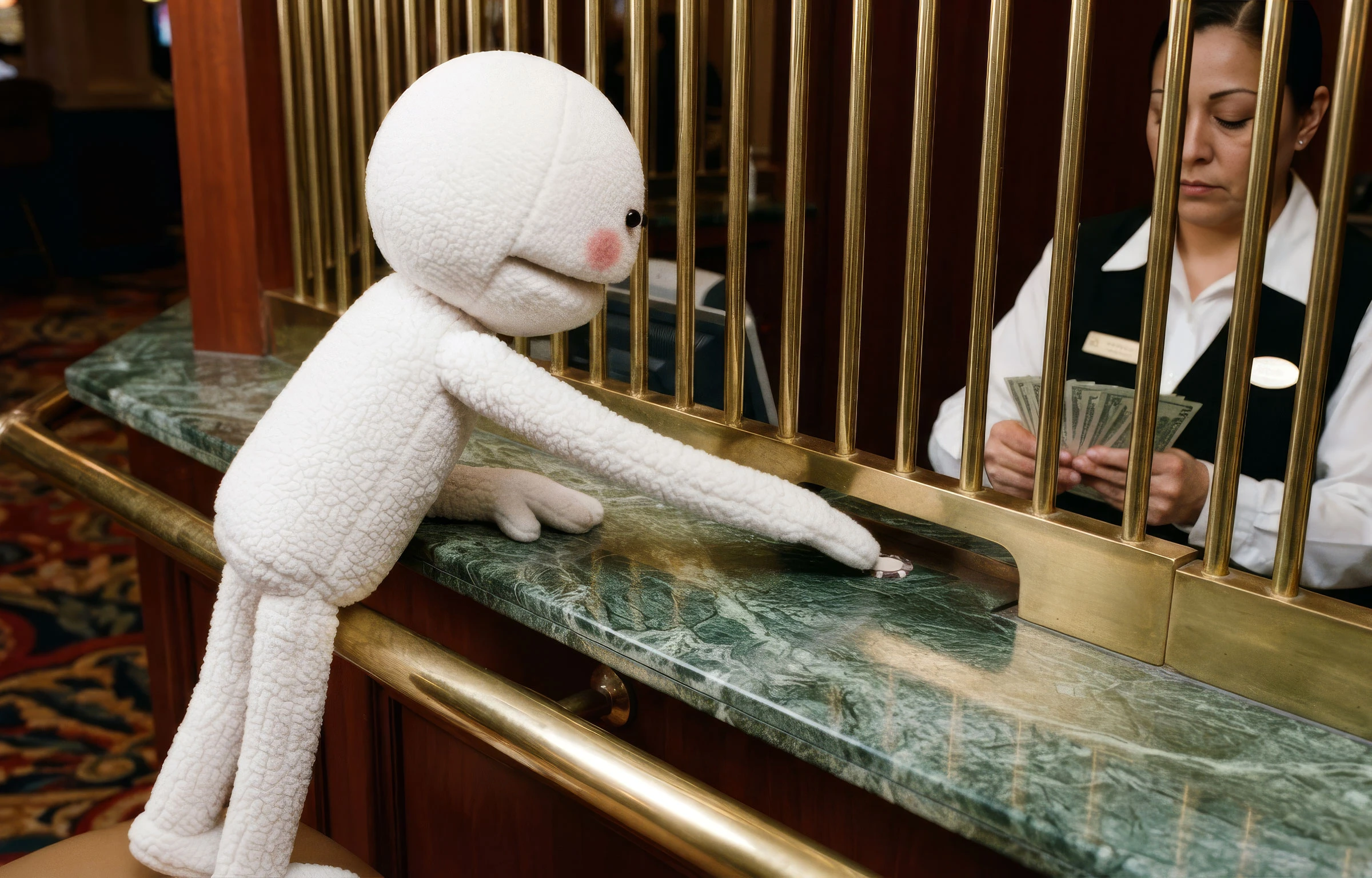
You hand the dealer a hundred-dollar bill and she doesn’t even look at you. She spreads it flat on the felt, squares it up for the camera in the ceiling, shoves it through a slot into a locked box, and slides back four green discs. And you say thanks. You THANK her. You just traded the full faith and credit of the United States government for four pieces of pressed composite from a building with no clocks, and you felt nothing.
I felt something. I always feel something.
The casino chip. On your feet.
Start with what it legally is, because you have never once asked. Under Nevada Gaming Commission Regulation 12, a chip is a “representative of value evidencing a debt owed by the issuing licensee.” That is the actual language. A chip is not money. A chip is an IOU. Every red disc on every table on the Strip is the building saying, in writing, I owe you five dollars. And the building STILL OWNS IT. The regulation says the chip remains the property of the casino. You don’t hold a chip. You are temporarily babysitting a promise.
And state law says you can’t spend it anywhere else. Not at the gas station. Not at the taco truck. Not at the gift shop across the street that sells shot glasses shaped like dice. The chip only means something inside the walls that made it. It is a sovereign currency with a territory the size of a carpet.
Now look at the object. Actually look at it. One and fifty-five hundredths of an inch across. A hundred and thirty thousandths of an inch thick, because the state wrote that down too. About ten grams in your palm, heavier than it needs to be and exactly as heavy as it should be. You call them clay. They are not clay. No casino chip since the 1950s has been all clay. It’s a composite, pressed in a mold under heat and pressure, the colored edge segments cut out and replaced, an inlay locked into the center until the whole thing becomes one object that cannot be taken apart. Some of them have RFID tags inside. Some carry UV marks you can only see under the blacklight at the cage. Microtext. Serial numbers. Those little stripes on the rim are edge spots, there so a dealer can read a stack from the side without lifting a single chip.
Here is the line in the regulation that ruined my afternoon. Every chip must be designed so that when it’s stacked with other denominations and viewed on closed-circuit black-and-white television, you can still tell what it’s worth.
Black. And. White.
Somebody wrote that into state law. The chip is designed for two audiences at the same time: you, holding it, and a surveillance camera that cannot see color. The red and the green and the black are for you. The pattern on the edge is for the eye in the ceiling. It is a coin that dresses for two rooms at once.
Wall Street stole its best word from this object. Blue was the high chip at the poker table, so the most valuable companies in the country got called blue chips. The stock market looked at a disc on the felt and said, we want to be that.
Your dollar bill cannot compete. Your dollar bill has been through the washing machine. Your dollar bill has been in a cab driver’s sock. The chip takes thousands of riffles, dealer drops, sweaty hands, and spilled beer, and it comes back to the rack looking like it was minted that morning.
December 14, 2010. A man in a motorcycle helmet walks into the Bellagio with a gun and walks out with about one and a half million dollars in chips, most of it in cranberry-colored $25,000 chips. A million and a half in private currency, out the door under a helmet.
And he couldn’t spend it.
The Bellagio discontinued the chips. One decision, and a million and a half dollars of IOUs stopped being IOUs. So he went on a poker forum to sell them under the username Oceanspray, for the cranberry, because he thought he was funny, and he ended up selling five of them to an undercover cop at the same hotel he robbed. He had been living there. He was COMPED. He lost over a hundred thousand dollars gambling in the building he held up.
You can rob a bank and the money still works. Rob a casino and the casino simply decides the money never existed. The currency defended its own house. It is the only money on earth that knows who it belongs to.
When a casino in Nevada closes, the state makes it keep redeeming its chips for at least 120 days, with notices printed in two newspapers twice a week, every week, like a funeral announcement for a currency. After that the window shuts and the debt is over.
I carry a one-dollar chip from the Stardust in my wallet. The Stardust closed in 2006. They imploded it the next year. There is no cage left to walk up to. There is no building left that owes me that dollar. It is worth nothing, and it is the only thing in my wallet I will never lose, because every bill in there is going to get spent on something stupid and the chip can’t be spent. It can only be kept. A promise from a building that is gone, still perfect, still readable on a black-and-white camera that nobody is pointing at it anymore.
That is what money should feel like. Heavy. Specific. Loyal to a place.
Stop calling it play money.