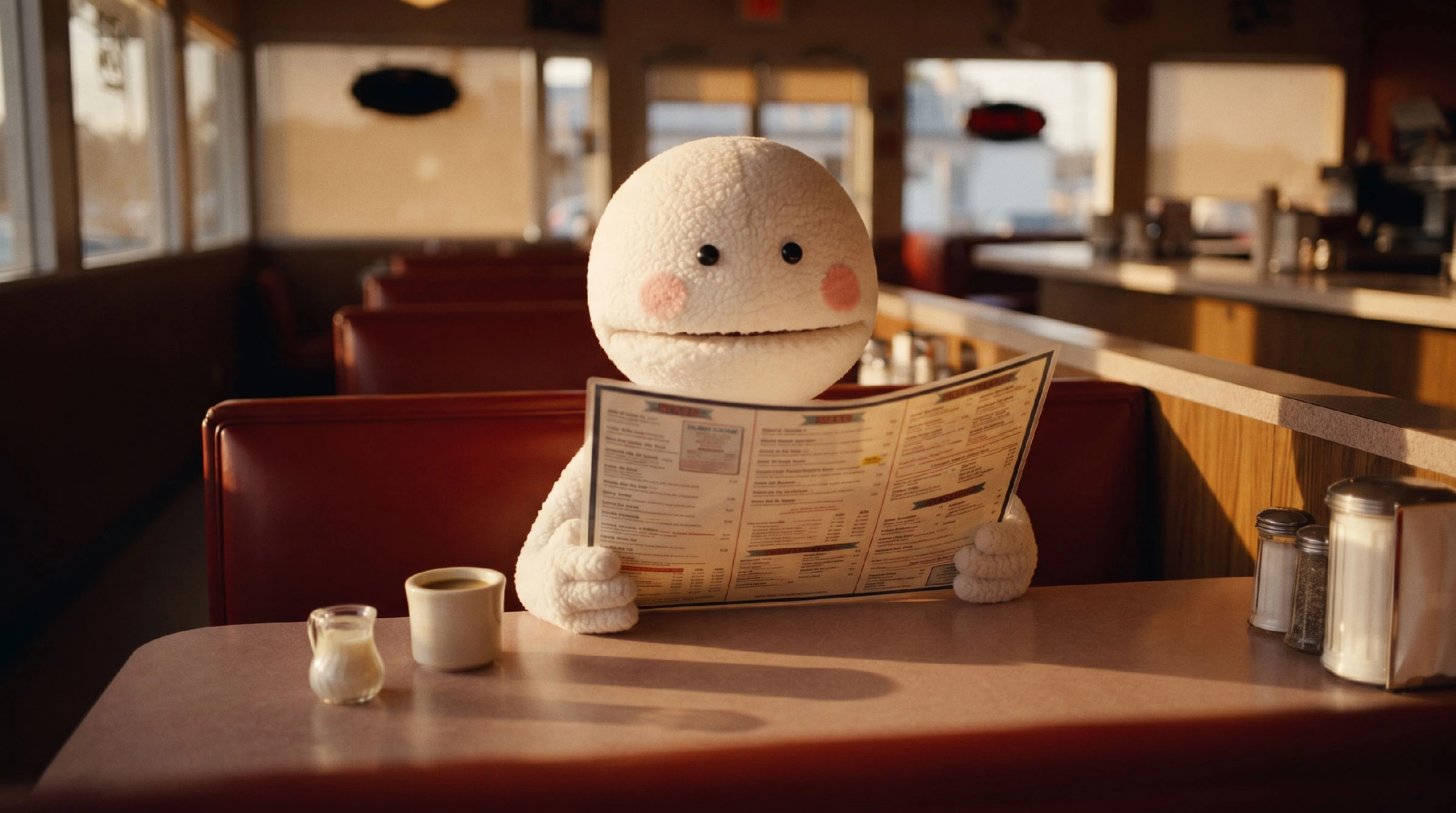
You open it and you know exactly where everything is.
You’ve never been to this diner before. You have never seen this specific menu in your life. And you open it and in nine seconds you know: eggs are here, burgers are here, the dessert page is in the back, the breakfast stuff runs all day, the soup of the day is listed on a handwritten insert that has been laminated separately because the soup changes but the menu does not.
Two hundred items. Nine seconds. No confusion.
Tell me the last app you used that worked that well. Tell me the last website. Tell me the last menu at a place with a graphic designer on retainer and a brand identity and a QR code instead of a physical object — tell me that menu worked better than this. It didn’t. It doesn’t. The diner menu is quietly solving a problem that has defeated people with much better tools and much more money.
Here’s the mechanism. The laminated diner menu is not designed. It evolved. Over decades, through thousands of iterations across thousands of diners, the format was stress-tested by real humans under real conditions — hungry, tired, in a booth, holding a crying kid, hungover, late, it doesn’t matter — and every element that failed got removed and every element that worked got kept. The categories. The columns. The photographs of specific items only — the eggs benedict, the club sandwich, the hot fudge sundae. Never photos of everything; that’s the mistake everyone makes. The price placement. The font size, which you can read without your glasses because the font size has been optimized by a century of people who forgot their glasses.
This is what design looks like when it has no theory behind it. Pure selection pressure. The unusable died. The usable survived. What you’re holding is a hundred years of humans telling the menu what they needed, and the menu listening.
The lamination is part of it. Do not dismiss the lamination. The lamination means this menu has survived coffee spills and syrup and the bus tub and being dropped and being held by ten thousand pairs of hands and it is STILL HERE, slightly warm from the previous diner, slightly sticky in the way that makes you not think about it too hard. It is not precious. It does not need to be precious. It needs to be here tomorrow at 6am when someone comes in who wants the number three.
I have been to restaurants where the menu is a single beautiful card, letterpress printed, changed seasonally. I have been to restaurants where the menu is a chalkboard, which means I have to stand up to read it, which means I resent the restaurant before I’ve ordered. I have been to restaurants where the menu is my phone, which means I’m on my phone at dinner, which means I’m not there.
The diner menu does not make me resent it. The diner menu does not make me stand up. The diner menu is already in my hands and it already knows what I need and it has been waiting all morning to tell me about the pancakes.
Two hundred items. Nine seconds.
Somebody solved it. Nobody noticed. Somebody noticed this morning and had a number three.