You crack it with one hand while you’re signing the check. You don’t even look at it. You read the little paper out loud in a fake voice, somebody at the table laughs, and you drop it on a plate of orange sauce and walk out.
You threw away a prophecy. You threw it in the SAUCE.
The fortune cookie. Everybody sit down.
First thing, and you are not going to like it. It isn’t Chinese. In Japan there is a cracker called tsujiura senbei, a folded crisp made with sesame and miso, with the fortune pinched into the fold on the outside instead of hidden in the middle. There is a Japanese woodblock print from 1878 of a baker grilling them. The thing was already a tradition before your great-grandparents were born.
Then it crossed an ocean. A man named Makoto Hagiwara ran the Japanese Tea Garden in Golden Gate Park, and sometime in the early 1900s he started serving a version of that cracker with a little note tucked inside. A San Francisco confectionery called Benkyodo took over making them and added vanilla, because Americans wanted it sweeter. Americans always want it sweeter. For decades the fortune cookie in California was a Japanese American cookie.
Then came 1942. Japanese American families were forced out of their homes and into incarceration camps, their businesses closed, and the bakeries that had been folding those fortunes went dark. Chinese American bakers and restaurants picked the cookie up and carried it forward. That is how it ended up next to your lo mein. The cookie has been through more than you have and it never once stopped showing up at the end of the meal.
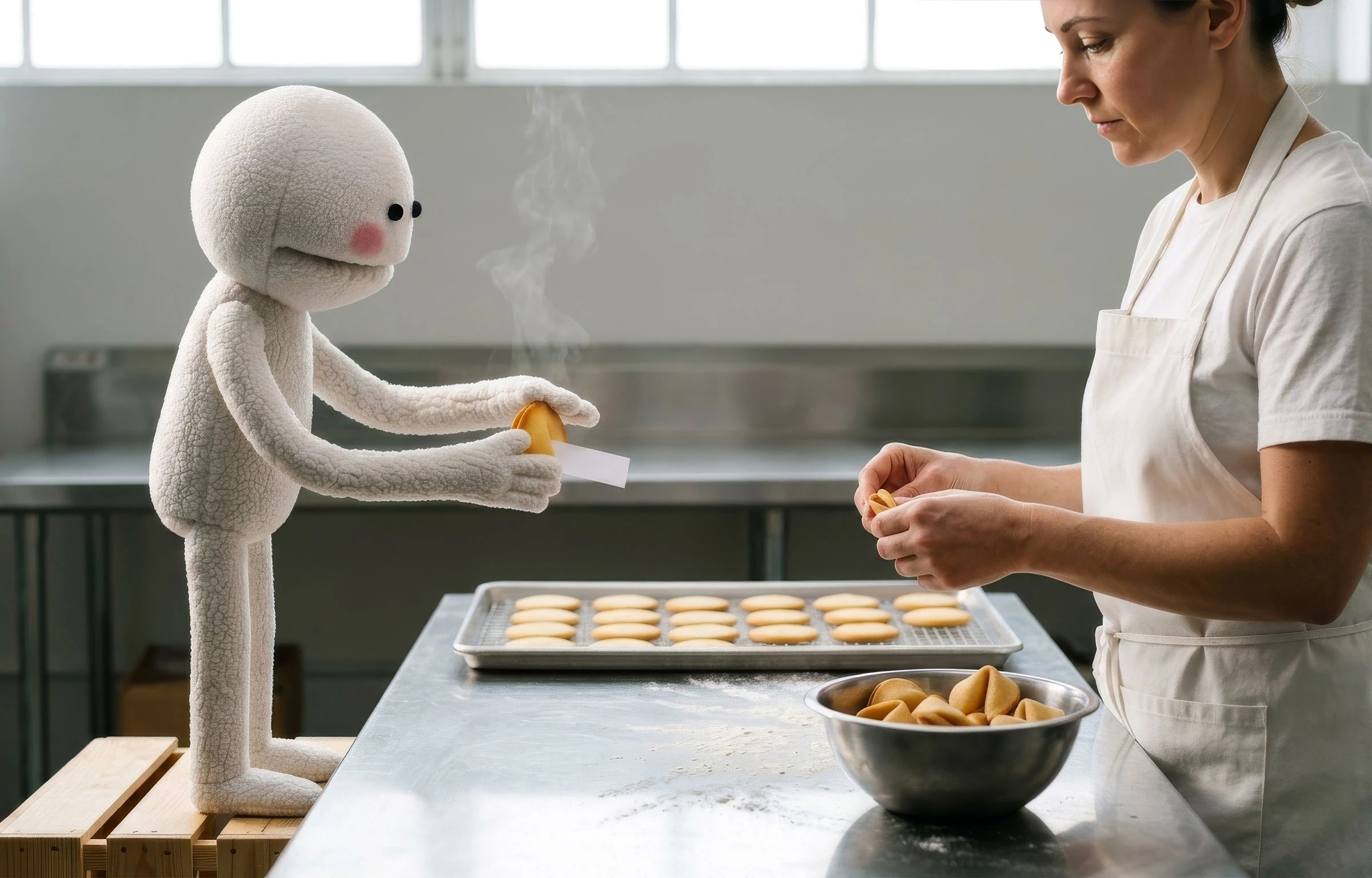
And look at how it’s made. A thin disc of batter comes off the heat, and the fold has to happen while it’s still warm and soft, paper slid inside, bent in half, bent again at the crease. That’s the whole trick. Wait too long and you’re holding a cracker. Every fortune cookie you ever ate is a tiny race against cooling that somebody won.
Now. March 30, 2005.
The Powerball drawing comes up and 110 people across the country hit second prize. Five numbers out of five. Each one of them walks away with somewhere between $100,000 and $500,000. The lottery people see that number and they panic. The lottery’s director said it was “out of the realm of possibility,” and they suspected a system error or a fraud. They start investigating.
It wasn’t fraud. It was a cookie.
Every one of those winners had played the numbers printed on the back of a fortune. Same numbers. Same factory. Wonton Food, in Queens, New York, which was turning out something like four million cookies a day and sliding the same lucky numbers into who knows how many of them. The first five matched the draw exactly. The sixth number on the slip was 40. The ball that came out was 42.
Off by two on a single ball. From a cookie. From a cookie you people throw in the sauce.
The company’s response was to say it would start letting a computer pick the numbers. The cookie was too good at its job, so they took the job away.
And somebody writes those little sentences. A man named Donald Lau was the chief fortune writer at Wonton Food for about thirty years. At his peak he was writing around a hundred fortunes a year. By 2017 he was down to two or three a month, and he stepped away with the only explanation a writer ever really owes anybody: “I have writer’s block.” He had written so many tiny futures for strangers that he ran out. He trained the next guy for six months and passed him the pen.
Think about that the next time you roll your eyes at “You will soon embark on a journey.” A human being sat at a desk and meant that for you. He wanted you to read it, maybe laugh, and come back next week. That was the entire plan. That’s more than most people want for you.
I keep every fortune I have ever gotten in a coffee can on top of my refrigerator. All of them. The good ones, the vague ones, the one that just said “Your shoes will make you happy today,” which, for the record, they did. I don’t read them. I just know they’re up there. Hundreds of small promises from strangers, folded while they were still warm.
The fortune cookie crossed an ocean, survived a war that shut down the people who made it, got adopted, went national, and nearly broke the Powerball. And it still costs nothing. It comes free with the check.
Stop throwing out the paper.