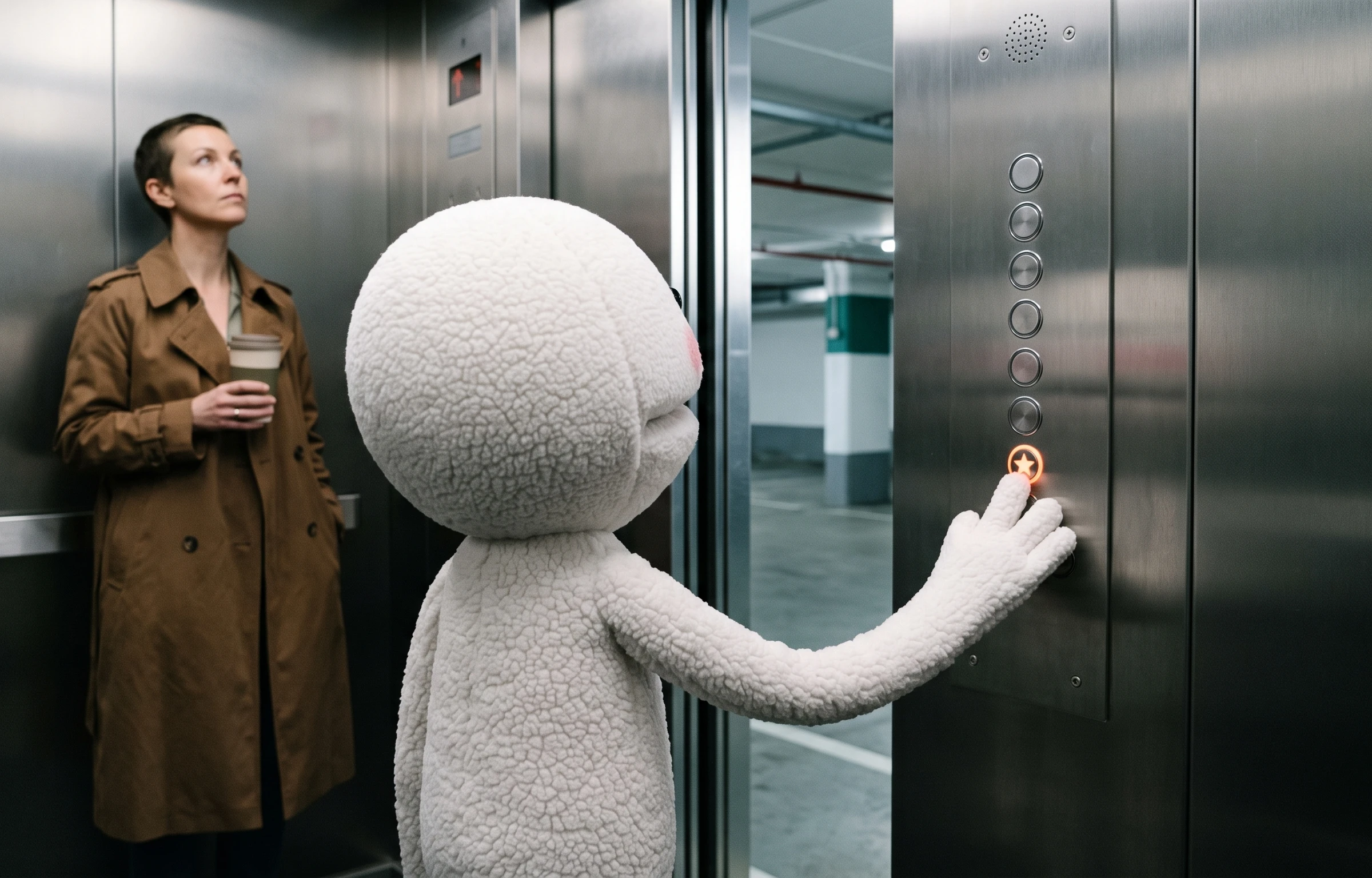
Level P3. You have no idea where you parked. You’re standing in a concrete box that smells like tires and wet pennies, holding your keys like a weapon, staring at two metal doors. A light comes on over one of them. It goes ding. You get in.
You did not listen to the ding.
The elevator was talking to you and you walked right into its mouth without hearing a word it said.
The parking garage elevator. Head down. Show some respect.
Under the 2010 ADA Standards for Accessible Design, the signal at the landing has to sound once for up and twice for down. Once. Twice. That’s the code, section 407.2.2.3, or the elevator can use a voice that says the direction out loud. So a person who can’t see the little glowing arrow still knows exactly which car showed up and exactly where it’s going.
One ding means up. Two dings means down.
You have heard that sound ten thousand times. You thought it was a doorbell. It was a SENTENCE. It was a building telling a stranger which way the world was about to move, in a language made of bells, and it has been saying it to you your entire life while you looked at your phone.
And it doesn’t stop there. The up button has to sit above the down button. That’s in the code too, because up should be up. The call buttons have to be at least three quarters of an inch across in the smallest direction, big enough to hit without looking. And on both sides of the door frame, on the jambs, there are raised floor numbers, at least two inches tall, with braille, so somebody who can’t see the display can put a hand on the frame and read what floor they’re standing on before they ever step inside.
Put your hand on the door frame next time. It’s there. It’s been there the whole time. Every elevator built to that code is covered in little notes written for people you’ll never meet.
Now the car. Every button in there is a number or a letter. P1. P2. 3. 4. Maybe an L. Maybe a G. Buildings can’t agree on what to call the ground, and that’s fine, because there is ONE button that doesn’t care what anybody calls it.
The star.
The main entry floor gets a star. Not a number. A raised star you can feel with your finger, and next to it, in braille, the word MAIN. It’s in the same federal code, section 407.4.7.1.3. The emergency stop gets a symbol. The alarm gets a symbol. Door open, door close, the phone. And the main entry floor. Out of every floor in the building, exactly one gets a shape instead of a name, and the shape is a star.
The government of the United States looked at a panel of buttons and decided the way out should be marked with a star.
That’s not signage. That’s a lighthouse.
Think about where you are when you need it. You’re on level P3 of a garage you don’t know, it’s late, the lights are buzzing, your car is lost somewhere in a gray field of other cars, and you just need to get back to the street where the world is. You don’t need to know if the street level is called L or G or 1 or Plaza or Level A. You just need to find the star. Press the star and the building will return you to the place you came in. That’s the promise. Somebody wrote it into law.
And inside the car the building has to keep telling you where you are, with a visible floor indicator and an audible one, so you’re never riding in a sealed box wondering. The elevator narrates. It is the most polite machine in the building and it is bolted to the grossest concrete in the city.
This is how I ride it. I press the star with my index finger, and then I leave the finger there for a second, flat on it, the way you’d put your hand on a dog. I feel the five points. I think about the person who can’t see the panel and has to find the way out with their fingertip alone, and I think about the fact that somebody made sure they could. I have never once been on the wrong floor when the doors opened. Not once.
The dings are a language. The jambs are a book. The star is a promise that there is a ground floor and you can get back to it.
You thought it was a box on a rope.
Listen for the ding.