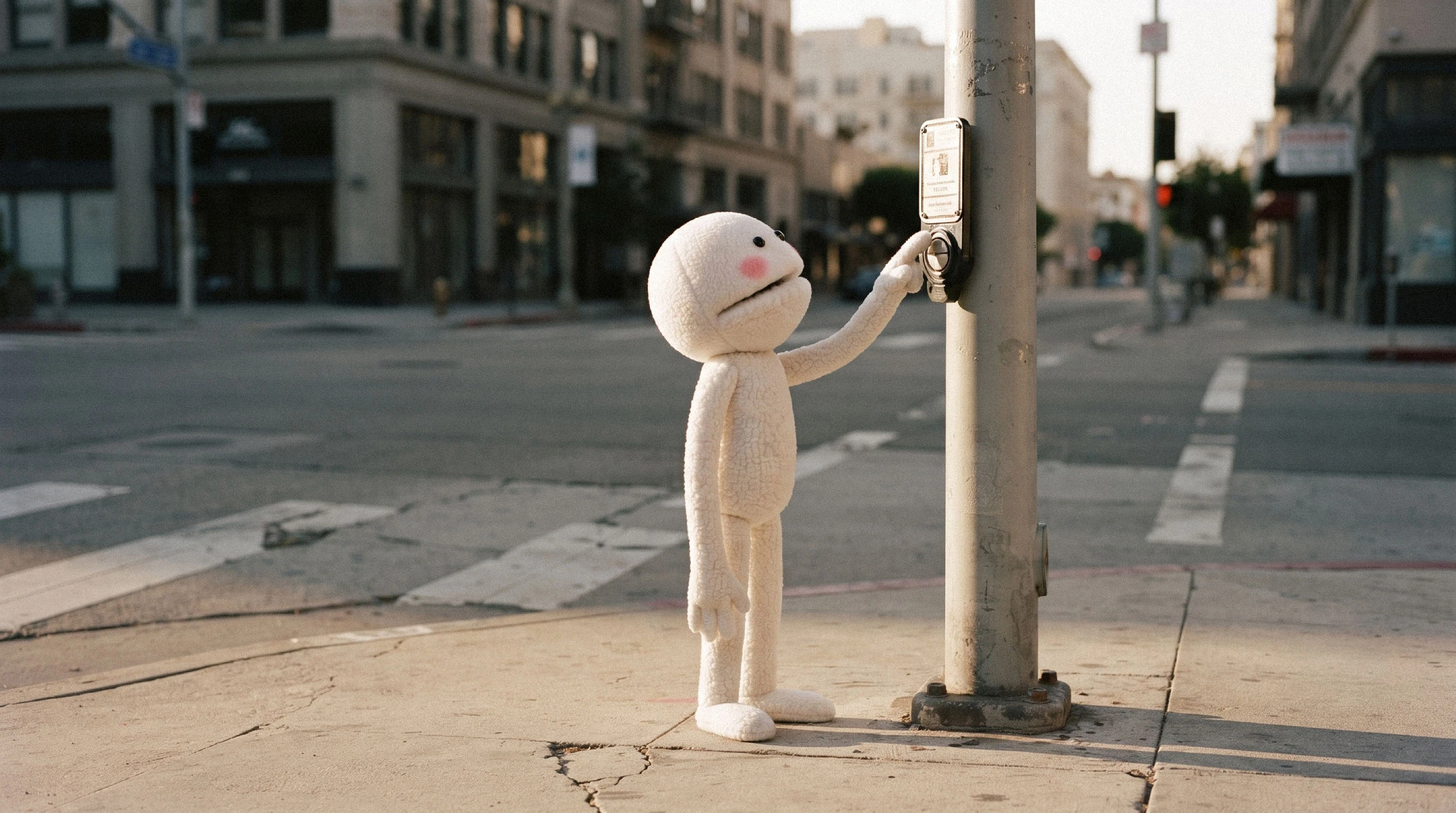
Press the crosswalk button. Go ahead. Press it. I’ll wait.
WAIT. Sorry — that’s the button’s line. It yells it at me too. In the voice of a substitute teacher. WAIT. Like I was about to do something. I was standing there holding a smoothie.
Here’s what I need you to sit with: the button is dead. New York computerized its traffic signals decades ago, and when they did, the vast majority of crosswalk buttons stopped being connected to ANYTHING. And the city looked at thousands of dead buttons and made a decision that explains all of America: leave them up. Removal costs money. Pressing feels good. Case closed.
The elevator door-close button? Dead since 1990. Federal accessibility law says those doors stay open long enough for everyone, period — the button only works for a firefighter with a key. You have spent your entire adult life jabbing a decorative circle to feel powerful in front of strangers.
Your office thermostat? There is a nonzero chance it’s connected to a wall and nothing else. Facilities people have admitted — IN TRADE PUBLICATIONS — to installing dummy thermostats because complaints drop when people can turn a dial. The dial goes nowhere. The complaints stop anyway. Think about what that means about us. Take your time. I’ve been thinking about it in a parking lot for an hour.
Now. You’re expecting me to be furious. A nation furnished with lies! Buttons of deceit! Wake up!!
No. Because here’s the thing the cynics can’t handle: the buttons work.
Not on the traffic. On YOU. The researchers call it illusion of control, and it’s not an illusion of results — pressing genuinely lowers your stress, shrinks the wait in your head, gives your hands a job while the universe takes its time. Somebody engineered a device with a parts cost of about four dollars that treats human helplessness at civilizational scale. That’s not a scam. That’s a public utility for the SOUL.
And it’s not even new. Prayer wheels. Votive candles. Worry stones. Rosaries. Humans have ALWAYS installed objects that do nothing to the world and everything to the person operating them. We’ve been building placebo buttons for five thousand years — we just used to be honest enough to put them in temples. Now we bolt them to poles on the corner of 6th and Broadway and let you believe you’re operating traffic.
The light was always going to change. The signal was already coming. The pressing was for you.
Press it anyway. Press it twice.
It helps.