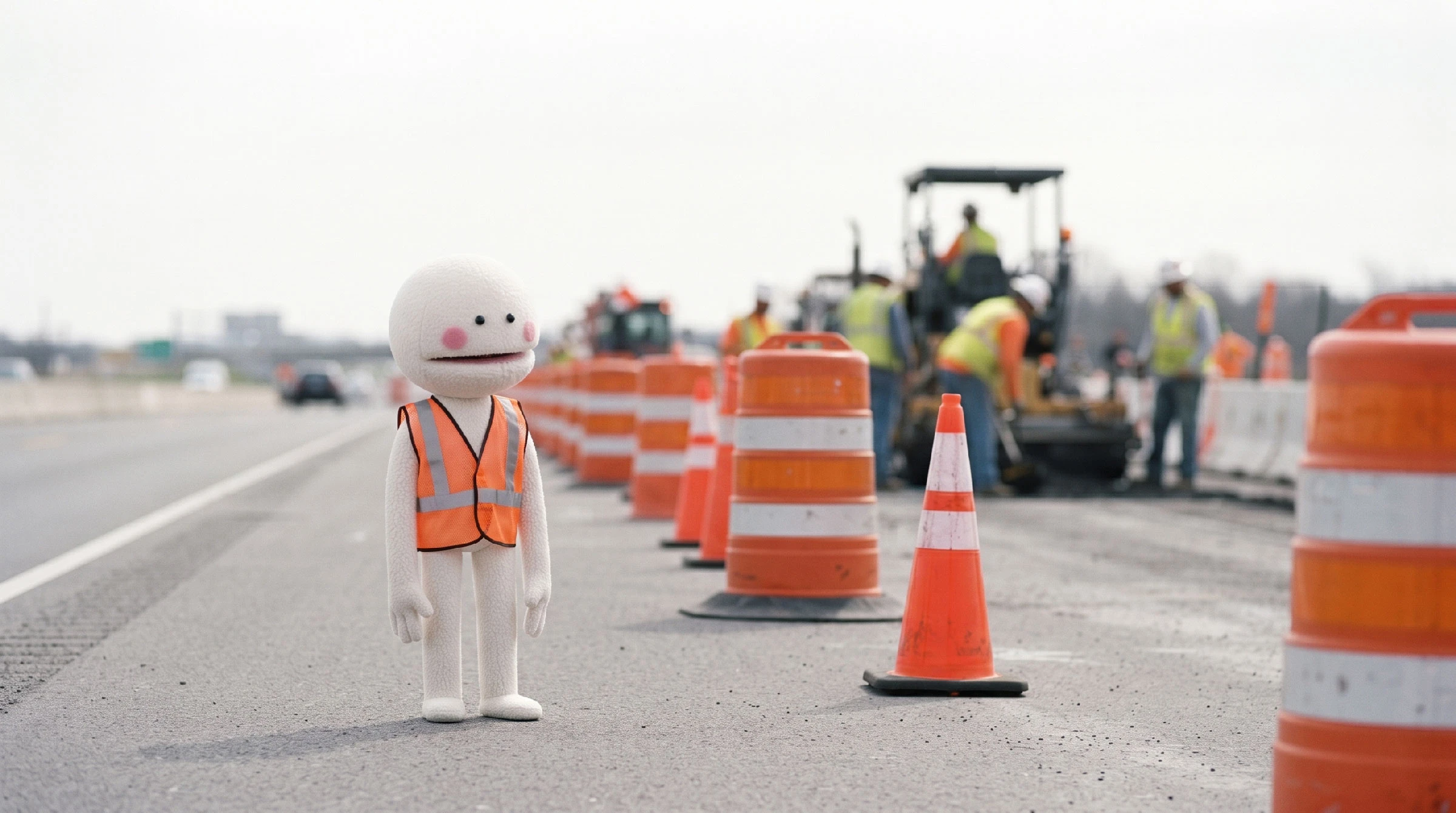
Nature made every color. Sunsets, coral reefs, poison dart frogs, the inside of a fig. Nature went completely insane with color for four billion years and produced essentially everything you have ever looked at.
Nature did not make safety orange.
Safety orange — the orange on the construction vest, on the hunting jacket, on the traffic cone, on the barrel at the highway work site — was ENGINEERED. Specifically. Deliberately. Because every orange that exists in nature blends into something. Fallen leaves. Rust. Dirt. Clay. Desert rock. The natural world is full of orange and every shade of it disappears into the landscape when you need to see it most.
So they made a new one. A frequency of orange so specific and so aggressive that the human visual system cannot ignore it. It registers before you consciously process it. Your brain flags it as OBJECT PRESENT before your eyes have finished looking. It is the only color in America that was designed with one job: make sure no one runs you over.
The American Standards Association — forerunner of ANSI — first put safety orange into a formal standard in 1945, at the request of the U.S. War Department. Revised in 1953. Refined again over decades until the chromaticity was locked to its current specification. The choice of this specific orange was deliberate: against blue sky, green foliage, gray concrete, brown dirt — it wins. Every time. Without argument. The complementary color of orange is azure. Put them next to each other and the contrast is violent. Your eye has no choice.
I think about the person who had to make that case. Who sat in a room with a color chip and said: this one will save lives. And then had to defend it. Had to show the contrast ratios, the visibility distances, the response times. Had to convince people that a color — a SPECIFIC SHADE of a color — was the answer to people dying at work.
They were right. High-visibility orange reduces worker fatalities. The research is not subtle. The color works.
And now it’s everywhere and you don’t see it anymore, which is the great paradox of safety orange. It’s the most visible color in America and it has become invisible through familiarity. You register it — your brain does the thing it’s supposed to do — and then you move on. The system works. The worker is protected. You drive past.
But for one second, before familiarity dulled it, every person who ever saw safety orange for the first time understood exactly what it was saying. HERE. HERE IS A PERSON. DO NOT HIT THIS PERSON.
Four billion years of nature. Every color imaginable. And they had to make a new one just to say: I am here.
They made it. It worked. Every road crew, every crossing guard, every hunter in the woods is wearing the proof.
Don’t take your eyes off it.