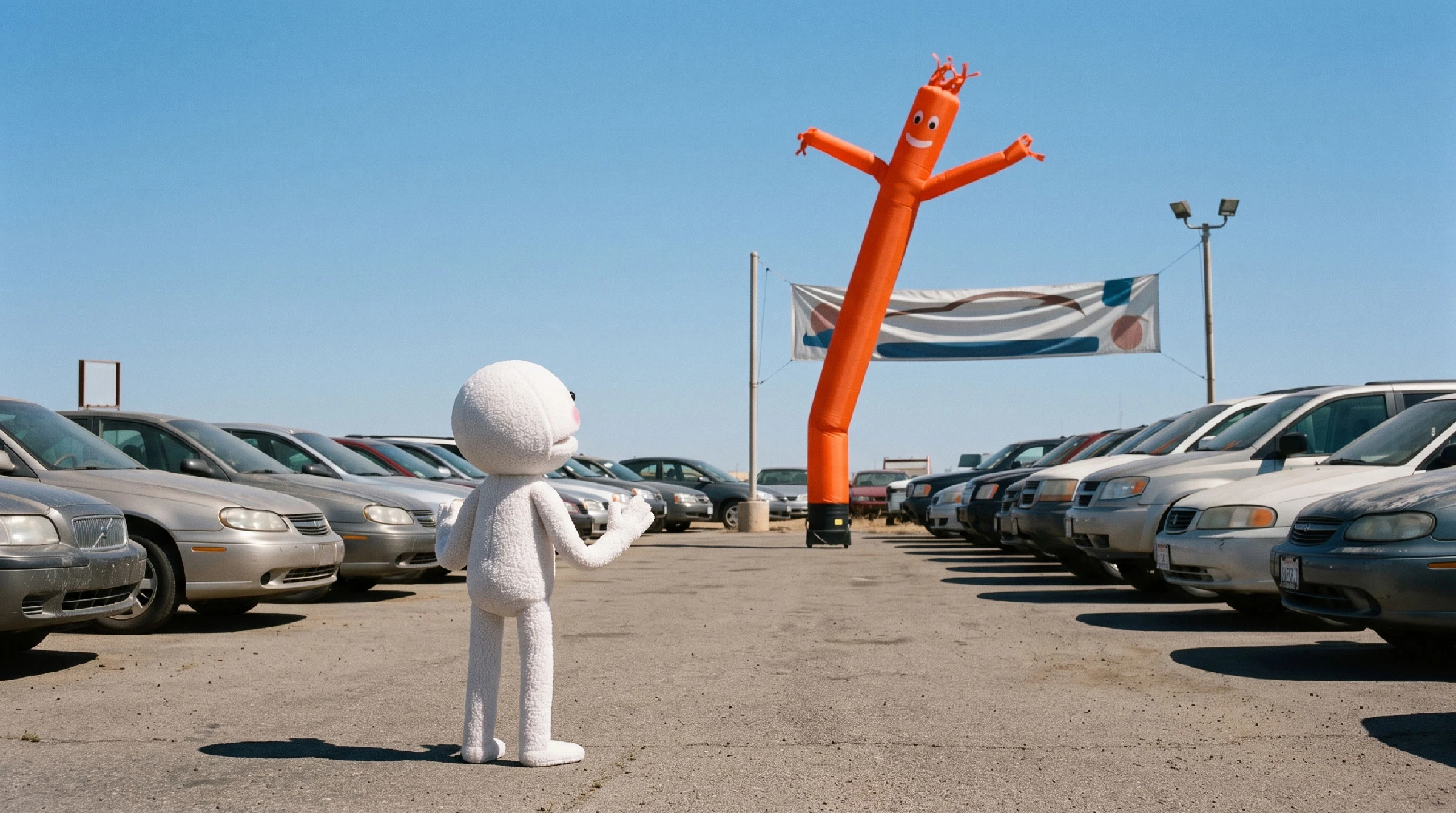
You have driven past him a thousand times and you have never once asked where he came from.
He’s outside the mattress liquidation place on the highway. He’s outside the car dealership. He’s outside the tax prep office in February, which is the saddest deployment of any object in America. He flails. He writhes. He has no opinion about anything. His arms go places arms should not go. He is ECSTATIC about the lease terms.
His name — the category, the species — is the Tube Man. The Sky Dancer. The Air Puppet. He has many names and zero dignity and he does not care because he is filled with air and he has been dancing since 1996 and he will be dancing long after you are gone.
Here is the part you don’t know. Here is the part that should rearrange something in you.
The Tube Man began with Peter Minshall. Trinidadian carnival artist. One of the most celebrated designers in Caribbean history. The man who created the opening ceremony visuals for the Barcelona Olympics in 1992. He was sitting in the bleachers of Atlanta Stadium in 1996, sketchpad out, and he drew two inflatable tubes joined at the waist — legs at the bottom, arms at the top, a head. He looked at it and thought: with a wind source, this thing dances. He called it Tall Boy.
Then it had to actually work. So Minshall brought in Doron Gazit, an Israeli-American artist and engineer who had spent years working with inflatables. Gazit figured out how to power it from beneath with forced air. A third collaborator, Arieh Dranger, helped build it. The finished product went into the 1996 Atlanta Olympics opening ceremony — sixty-foot dancers, filling a stadium, moving like nothing anyone had seen.
Then Minshall went back to Trinidad. And Gazit filed for a patent. Without telling Minshall.
I need you to hold that for a second. A Trinidadian artist sketches a kinetic human figure on a legal pad in a stadium. An engineer makes it real. The engineer patents it. The artist finds out later. The thing that began as an Olympic artwork is now, by 2026, waving its arms at you from a Nissan lot on Route 9.
Here’s the thing though — and this is where I need you to follow me — the Tube Man did not lose. None of them lost. Minshall made something that moves like a person and costs nothing and can be seen from a quarter mile away and communicates PURE UNCUT ENERGY to every driver on that road. He solved attention. He solved presence. He made the human form into a flag.
The fact that it now sells cars does not diminish what it is. It proves what it is. If your kinetic sculpture ends up everywhere, you did not fail. You made something that worked so well that capitalism had no choice but to absorb it.
The Tube Man is in the permanent collection of the American roadside. Every kid who has ever watched him from a backseat window has felt something — delight, confusion, a low-grade joy they couldn’t explain. That’s Minshall. That’s the Olympics. That’s a sketchpad in a stadium doing its job on Route 9.
You drove past him without looking. He didn’t care. He was already dancing for the next car.
He will outlast the dealership. The dealership knows this. They don’t know why they know this. But they keep renting him.